Image: © YAKOBCHUK VIACHESLAV /shutterstock
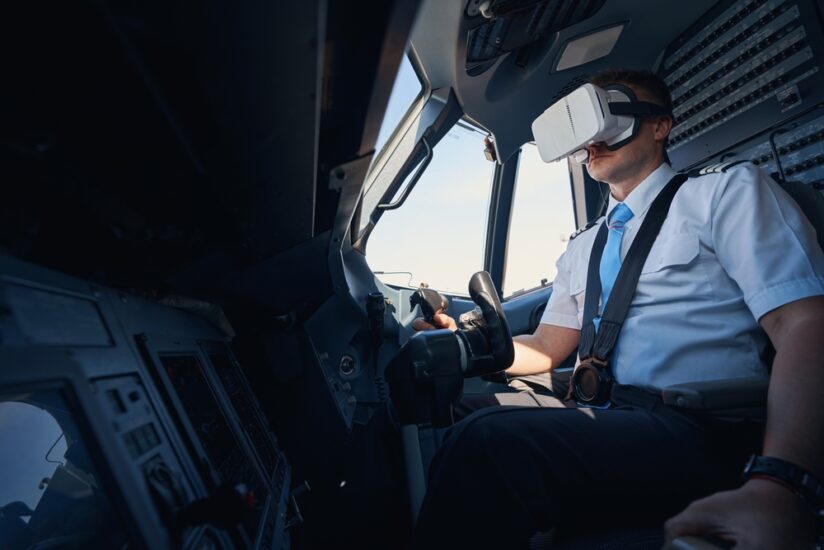
The question is no longer whether VR technology has a place in pilot development but rather how to integrate it strategically within existing training programs.
According to Diako Rad, director of flight operations at KlasJet, full flight simulators (FFS) remain unmatched for high-fidelity handling, upset recovery, and regulatory checking, but “VR already shows strong potential as a procedural and situational awareness trainer, especially when pilots are new to type or transitioning between aircraft. VR enables repeated rehearsal of flows, abnormal procedures, and even client interaction or cabin scenarios without time pressure or device booking.”
VR allows crews to build familiarity before entering the simulator environment, explains Rad. “For multi-pilot or high workload operations, VR offers a useful platform to rehearse workload management, callouts, and decision-making. It may not replace a full flight simulator yet, but it clearly has potential to reduce wasted simulator time by covering basic familiarisation outside of the device,” he says. “VR can realistically support flexible, remote training for crews with irregular schedules. This is one of its strongest advantages, as it enables pilots to rehearse flows, practice emergency scenarios, or review complex airport layouts from home or during layovers. This removes dependency on simulator availability for early-stage familiarisation. However, any remote training must still be monitored or reviewed by instructors to maintain training quality. Flexibility must not come at the cost of accountability.”
Gilad Scherpf, senior director, aviation training development, at Lufthansa Aviation Training (LAT), says that a holistic instructional design concept, in combination with the competency-based training and assessment (CBTA) philosophy, ensures the right selection of both traditional and new training tools and media. “This is the ‘competency-to-tool approach,’” he says.1
A non-immersive 3D device is more suitable for knowledge retention, and an immersive VR device decreases training time and the amount of instructor assistance required for practical skill acquisition, according to Khenak et al. “Non-immersive and immersive devices could be used in a complementary manner to optimise different training acquisitions, the former for knowledge retention, such as knowing which engine number to start first in an aircraft, and the latter for skill practice, such as being able to interact correctly with the appropriate controls,” the researchers say.
As a general practice, LAT conducts trials of all novel or significantly adapted tools and technologies regarding their specific feasibility for the intended use, according to Scherpf. “Small changes, such as hardware or software alterations, can have a large impact on the training outcome. Therefore, training effectiveness must be proven in an operational environment.”
Based on trainee feedback collected from multiple VR training cases since 2019, LAT has observed that the overall trainee engagement rate is at the same level or greater, compared to traditional simulation methods. “Another internal conclusion is that an increase of training efficiency can be expected based on time gains or parallelisation of training,” says Scherpf.
Simulation Tools
According to training provider FlightSafety International (FSI), mixed reality (MR; a mix of the real world and the digital world) is not intended to replace traditional simulation but to complement it. “Our VITAL MR technology enables pilots to interact with physical cockpit elements while being immersed in high-fidelity virtual environments. This speeds up foundational training tasks, such as cockpit familiarisation and basic flight procedures,” the FSI team says. “Leveraging MR can help pilots experience scenarios that a full flight simulator alone may not fully replicate. Since the technology is more accessible, it reduces the reliance on in-air training and creates a safer, more controlled environment while strengthening readiness. MR is always deployed within a structured curriculum, ensuring consistent instructor oversight, real-time feedback, and rigorous assessment integrity. The integration of tactile cockpit elements and instructor tools such as virtual laser pointers helps preserve training quality, even when immersive technologies are introduced.”
CAE’s Mobile Immersive Trainer (CAE MIT) complements CAE’s current training offering and contributes to improved pilot preparation, says Erick Fortin, senior director of incubation at CAE. The app allows pilots to familiarize themselves with the flight deck, practice critical procedures, and develop muscle memory for key functions, so they are ready for their FFS sessions and can potentially learn more procedures in those sessions. “This … is a portable solution, meaning they can train outside a training centre, such as from home or a hotel room.”
Regulatory Framework
CAE has ongoing pilot projects and trials, both internally and with selected customers. “We are also working with some academic institutions and aviation authorities,” Fortin says.
The European Union Aviation Safety Agency (EASA) has already approved specific VR-based training modules, which indicates that the technology is being taken seriously at the regulatory level, according to Rad. “VR will most likely gain recognition first as a procedural or part task trainer within ATO [air training organization] syllabi rather than replacing full credit checking events. Approval depends on objective performance tracking, instructor oversight, and alignment with company standard operating procedures (SOPs),” he says.
Scherpf observes that the latest initiatives for regulatory updates do not provide the full flexibility of the “competency-to-tool” approach but instead continue to follow a “task-to-tool” logic. “Both the International Civil Aviation Organization (ICAO) and regulatory bodies such as the [U.S.] Federal Aviation Administration (FAA) and EASA have extensively discussed the possibility of granting greater freedom,” he says. “Nevertheless, from a safety perspective, it remains rational to rely on controlled and proven environments such as FFS. Any deviation from minimum training requirements must therefore be grounded in thorough analysis and demonstrable outcomes. Such an approach can be supported through enhanced responsibility and oversight by [ATOs] and their implemented training programmes.”
Human Factors
The integration of immersive technologies in aviation training comes with several challenges, such as cybersickness (nausea or related symptoms associated with online scrolling) or cognitive overload, generally arising from poorly designed training environments, explains Scherpf. “Based on accumulated experience, most issues can be mitigated by addressing physiological needs, including the synchronisation of virtual and physical motion cues, limiting scenario duration, and providing comprehensive introductions or tutorials,” he says.
FSI’s engineering division has studied how cybersickness, sensory overload, and adaptation issues affect training effectiveness. “Findings show that aligning physical cockpit elements with immersive visuals, dynamically adjusting light levels, and integrating night vision goggles (NVGs) … help reduce disorientation and cognitive fatigue,” the FSI team says. “Our approach is to integrate MR into a broader curriculum, balancing exposure to head-mounted displays with ground school, flight training devices, and full flight simulators.”
According to Rad, the adoption of VR in aviation training depends on credibility and physical comfort. “Some pilots embrace VR immediately due to previous exposure to gaming or technology, while others remain cautious until they see structured application. Ergonomics and realism are critical,” he says. “The cockpit scale, response latency, and control feel must be accurate to avoid negative learning. Instructor presence is also essential. VR should be a guided training tool, not an isolated experience.”
Integrating VR Into Training
The needed holistic approach in the implementation of VR training must be based on a structured instructional design process and must typically lead to a hybrid use of new, as well as conventional, technologies, according to Scherpf. “The related organisational strategy should include an innovation-friendly environment such as projects with a research and development focus (i.e., prototyping, industry/academic collaboration, as well as constant validation and adaption). Metrics help to confirm the resulting training effectiveness and can extend from economic [key performance indicators] to measurement of competencies and traditional feedback,” he says.
The correct strategy is gradual integration, according to Rad. “It is first necessary to identify clear-use cases such as cockpit familiarisation, procedural drills, or cabin- and passenger-related scenarios, and then align VR content with existing SOPs,” he says. “In this context, it is necessary to ensure that instructors can observe, debrief, and document performance. The return on investment should be measured in improved simulator readiness, reduced time to proficiency, and increased scenario coverage rather than pure hourly cost comparison with full flight simulators.”
VR will not fully replace FFS in the near term, but it is already mature enough to supplement procedural learning, increase accessibility, and improve pilot engagement, according to Rad. “We view VR not as an alternative to certified simulators, but as a valuable extension of them,” he says. “The future of training lies in combining traditional simulator fidelity with the flexibility and repetition capability of VR.”
The integration of VR technology into aviation training is not a revolution, but an evolution that is being approached in operational realities. VR has already moved beyond the experimental status to become a practical tool for specific training applications, particularly procedural familiarization, cockpit orientation, and early-stage skill development.
The value of VR lies not in replacing FFS but in extending training capability beyond the traditional constraints of device availability, geographic location, and scheduling inflexibility. The regulatory environment, while still evolving, shows promising movement toward recognizing VR as a legitimate training tool within approved curricula.
VR technology will not replace FFS in the foreseeable future. Instead, it represents a valuable extension of training capability that, when implemented strategically, can address specific business aviation challenges while maintaining the safety standards and training quality that regulatory oversight demands.
Mario Pierobon, Ph.D., is the owner and scientific director of a safety consulting and training organization.
Note
- An example is provided by Nawel Khenak, Cédric Bach, Stéphane Drouot, and Florence Buratto in “Evaluation of Virtual Reality Training: Effectiveness on Pilots’ Learning.” IHM’23 – 34e Conférence Internationale Francophone sur l’Interaction Humain-Machine, AFIHM; Université de Technologie de Troyes, Apr 2023, Troyes, France. hal-04046414