Crew resource management (CRM) is more than a classroom topic. At its best, it can show an airline certain aspects of the human side of performance before they figure in an accident report.
Working with hundreds of pilots, cabin crewmembers, instructors, check airmen, safety professionals, and operational leaders, I have seen that crew performance depends on much more than technical skill. I have sat in the back of simulators and watched crews handle engine failures with calm precision, then struggle when the problem became unclear, when the automation did something unexpected, or when one pilot hesitated to challenge the other. I have heard crews describe the same difficult event in completely different ways. I have seen first officers notice something was wrong but struggle to find the words to intervene, and captains who were technically skilled but unaware of the tone they had set on the flight deck.
These are not simply “communication problems.” They are human factors problems expressed through CRM.
CRM shows us what people do together during an operation. Human factors helps explain why they do it. One gives us the behaviors we can observe; the other gives us the context we need to understand and improve them.
CRM is often described as a set of skills: communication, teamwork, leadership, followership, monitoring, decision-making, workload management, and situational awareness. That is true, but it is not the whole story. CRM is also one of the clearest ways that human factors shows up in daily airline operations. It is where fatigue, stress, attention, memory, hierarchy, culture, automation, procedures, and organizational pressure all meet the real-time work of flying an aircraft.
After many years working inside two airlines, I have come to believe that the most important question is not, “Did the crew know CRM?” It is, “Did the system help the crew use CRM when it mattered?”
The Work Behind the Words
From the outside, CRM may look like regulatory compliance, recurrent training, and classroom discussion. But if CRM is treated as just another requirement to get through, its purpose is lost. The box may be checked, but the behavior may not change. Inside an airline, the real work is broader and more delicate.
A CRM and human factors practitioner (or trainer) moves constantly between training, operations, safety data, and leadership conversations. The work involves pilots, cabin crew, dispatchers, maintenance, training, standards, safety, data analysts, and senior leaders.
A typical month may include reviewing safety reports for recurring themes; speaking confidentially with crewmembers after an event; helping instructors distinguish technical performance from crew interaction; updating scenarios to reflect current risks; examining fatigue or workload behind a reported error; and preparing leaders to hear uncomfortable messages without turning them into blame.
This is where the practical work begins. A missed callout may look like poor monitoring, but it can also point to workload saturation, expectation bias, fatigue, distraction, or a procedure that is hard to use. A weak intervention may look like lack of assertiveness, but it can also point to rank gradient, cultural norms, previous negative experiences, unclear policy, or the captain’s communication style. A decision to continue an unstable approach may look like poor judgment, but it can also reflect plan continuation bias, schedule pressure, weather avoidance, company norms, or a training environment where go-arounds are treated as unusual instead of normal.
What CRM Looks Like in Practice
When I observe a crew, I don’t begin by asking whether they are “good at CRM.” I look for how they build and maintain a shared picture of the operation.
Who is speaking, and who is quiet? Is the pilot monitoring actually monitoring, or simply waiting for the next checklist item? Are concerns stated early, clearly, and with enough force? Does the captain invite challenge? Does the first officer seem comfortable moving from a routine callout to a safety intervention? Does information from the cabin crew reach the flight deck in a way that affects decisions? Are dispatch and maintenance inputs treated as part of the operational picture?
Good CRM is often quiet. It is a captain saying, “Let’s slow this down.” It is a first officer saying, “I’m not comfortable continuing.” It is a cabin crewmember saying, “This does not look normal,” and being taken seriously. It is a dispatcher asking, “Do you want to reconsider the plan?” It is a maintenance controller clarifying uncertainty rather than allowing an assumption to stand.
Poor CRM is not always dramatic. It may be polite, orderly and procedural — but incomplete. The crew may complete every checklist while never discussing the real uncertainty. They may make all required callouts but fail to challenge the plan. They may brief the approach but not discuss the threat that matters. The absence of conflict is not the same as effective teamwork; sometimes, the safest cockpit is the one where disagreement can be voiced early and respectfully.
Human factors are just as important as CRM behaviors. I watch for fixation, narrowing attention, rising pace, unexplained silence, rushed checklists, changes in tone, and signs that one crewmember is carrying too much of the mental workload. In debriefs, I listen for phrases such as, “I thought he had it,” “I assumed she saw it,” “I was waiting to see what would happen,” or “I didn’t want to make it worse.”
Those comments are revealing. They expose the mental model behind the behavior.
The Conversation After the Event
The most important CRM work often begins after a simulator session, line check, or operational event. The debrief is where learning either opens or shuts down.
If the first question sounds like an accusation — “Why didn’t you speak up?” — the conversation is already moving in the wrong direction. A better opening is, “Walk me through what you were seeing at that point.” Or “What cues were available to you?” Or “What did you think the other pilot understood?”
The goal is not to excuse poor performance. The goal is to understand it well enough to prevent it from recurring.
In a good debrief, the practitioner helps the crew reconstruct the event from the inside out. What was each person attending to? What did each believe was happening? What was expected? What was surprising? What pressures were present? What made the decision seem reasonable at the time? What made speaking up easy or difficult? What was not said?
A useful question is, “Where was the first point at which the outcome could have changed?” Another is, “What would have helped you challenge the plan earlier?” These questions move the discussion from blame to practical intervention.
Here is how that kind of debrief might sound:
Practitioner: “You made the stabilized approach callout. What did you expect to happen next?”
First officer: “I expected the captain to correct it or go around.”
Practitioner: “When that did not happen, what options did you feel you had?”
First officer: “I could have been more direct.”
Practitioner: “What would ‘more direct’ have sounded like in your cockpit?”
Captain: “If he had said, ‘Go around,’ I would have gone around.”
Practitioner: “So one learning point may be that the standard callout identified the deviation, but the situation required an intervention. Let’s talk about the difference.”
That difference — between a callout and an intervention — is one of the most important lessons in CRM. A callout shares information. An intervention tries to change what happens next.
Picture a crew flying an approach in marginal weather after a long duty day. The aircraft is high and fast. The first officer makes the required callout, and the captain responds, “It’s coming back.” Below the stabilization gate, the aircraft is still outside parameters, but the first officer does not escalate. The aircraft lands long.
On paper, this may look simple: unstable approach, no go-around. In real life, it may reveal much more. The callout did not become an intervention. The captain may have been affected by workload or expectation bias. The crew may have treated stabilization criteria as flexible, or the organization’s culture may have allowed continuation to become normal. The case may begin with one crew, but it may also point to training, checking, data trends, leadership messages, or a wider normalization of deviance around approach stability.
Authority, Culture, and the Moment of Challenge
Many people think authority gradient means a junior person is afraid of a senior person. Sometimes that is true. More often, it shows up in quieter ways.
A first officer may hesitate because the captain is respected. A cabin crewmember may soften a concern because the flight deck sounds busy. A dispatcher may share information without clearly recommending a change. A maintenance technician may assume the crew has understood what a defect means. No one is trying to hide information. The problem is that important signals can get weaker as they move from one role to another.
CRM training must therefore teach language, not just concepts.
“Captain, I’m concerned” is stronger than repeating a data point.
“I recommend we discontinue the approach” is stronger than “We’re still a little high.”
“I need you to acknowledge this” is stronger than hoping the message has landed.
But assertiveness is only half of the equation. The senior person must create the conditions for assertiveness to work. A captain who says, “Tell me if you see anything you don’t like,” but reacts defensively when challenged, has not created psychological safety. A training captain who rewards technical perfection while ignoring crew climate teaches the wrong lesson. A senior leader who says safety comes first but questions every go-around for efficiency reasons sends a message crews will hear clearly.
Human factors teaches us that people do not speak or remain silent in a vacuum. They respond to context, perceived consequences, workload, ambiguity, and prior experience.
Automation and the Evolving Role of CRM
Modern automation has changed CRM but has not reduced its importance. In some ways, it has made CRM more subtle.
Mode awareness is a team activity. It is not enough for one pilot to understand what the aircraft is doing. The crew must share that understanding, especially during high workload or unexpected changes. Automation confusion often appears first as a communication problem: vague statements, delayed corrections, eyes inside the cockpit, repeated selections, incomplete verbalization, or one pilot asking, “What is it doing now?”
A purely technical debrief may focus on the wrong mode selected. A CRM and human factors debrief asks deeper questions: What did each pilot think the automation was doing? When did their mental pictures start to differ? What cues were available? Was anyone monitoring the flight path while the other pilot managed the system? Did the crew verbalize mode change? Did workload get in the way of cross-checking?
Automation is not just equipment. It is part of the human-machine team. CRM must include the machine as one of the “resources” being managed, questioned and monitored.
Why CRM and Human Factors Belong Together
CRM and human factors should not be taught or managed as separate ideas. CRM without human factors can become a checklist of expected behaviors. Human factors without CRM can stay too abstract for daily operations. Together, they turn theory into practical learning: why people missed a cue, why a challenge did not land, why a decision made sense at the time, and what would make a safer response more likely next time.
Perhaps the greatest mistake organizations make is reducing human factors to “human error.” Human error is often when the investigation begins, but it should not be where learning ends.
When a crew makes an error, the practitioner should ask: What made the error possible? What made it likely? What defenses worked? What defenses failed? Was the procedure usable? Was the training realistic? Was fatigue managed? Were the cues clear? Was the workload reasonable? Was the policy understood? Did the culture support the safest choice?
CRM information should feed the safety management system, not remain isolated in training. Patterns from debriefs, simulator sessions, line checks, safety reports, flight data monitoring, observations, and incident investigations can reveal weak signals. Used well, CRM helps crews adapt when conditions change, maintain a shared picture under pressure, and recover when plans, assumptions, or defenses begin to break down.
CRM should evolve as an operation changes. New patterns from debriefs, reports, simulator sessions, and research should feed back into training, so CRM does not become a fixed syllabus repeated year after year.
The practitioner’s role is to help the organization connect these dots: If several crews hesitate to go around, that is not only a crew issue. If instructors struggle to debrief leadership behavior, that is not only an instructor issue. If cabin crew repeatedly say their concerns are not heard, that is not only a cabin issue. If crews report fatigue but schedules remain unchanged, that is not only a fatigue-reporting issue.
These are organizational learning opportunities.
Lessons From the Field
After years in this work, I have learned a few lessons.
First, crews usually want to do the right thing. Most unsafe outcomes are not produced by indifference, but by people trying to manage complexity with imperfect information under pressure.
Second, the best CRM practitioners are curious before they are corrective. They ask better questions. They listen for what is not being said. They understand that silence, hesitation, and defensiveness are data.
Third, the success of CRM depends on an atmosphere of psychological safety. That atmosphere is weakened by mixed messages from the top. Leaders may not intend to discourage speaking up, going around, reporting fatigue, or admitting uncertainty. But if those behaviors are questioned, second-guessed, or tacitly looked down upon, crews will eventually get the message. They will still attend the training, but the training will not shape their behavior.
Fourth, human factors must be practical. Crews do not need abstract lectures on cognition when they are tired, overloaded, or uncertain. They need usable prompts, shared language, realistic practice, and leaders who support safe decisions.
Finally, CRM is not something an airline “has.” It is something an airline does, every day, in small moments: a question asked, a concern acknowledged, a plan reconsidered, a debrief conducted honestly, a trend reported without blame, a leader choosing learning over defensiveness.
The future of CRM is not another acronym. It is the disciplined application of human factors to real operations, so that when a situation becomes ambiguous, stressful or time-critical, the human system is as prepared as the technical system.
That is the work. And it is never finished.
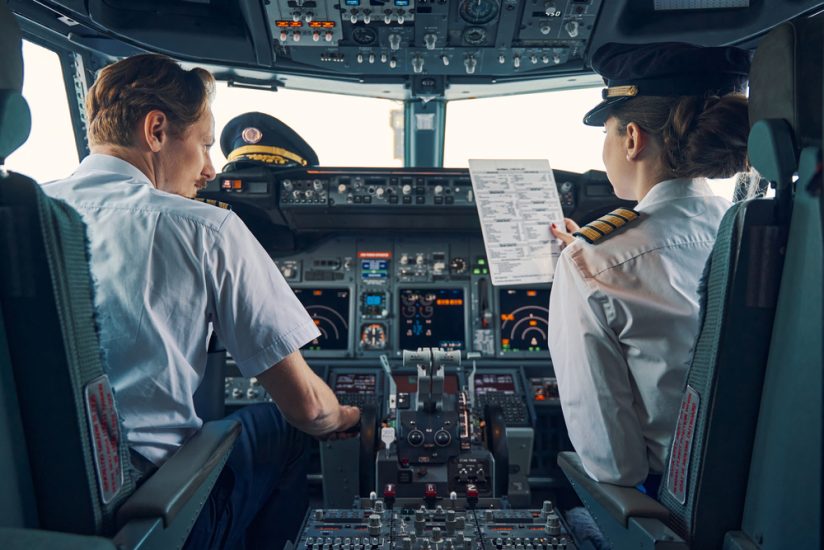
Image: YAKOBCHUK VIACHESLAV / Shutterstock.com
Rithi Baruah, Ph.D., is the former head of human factors and CRM at Air India and previously led human factors and CRM at Vistara. She holds a Ph.D. in aviation psychology and was honored in 2023 by India’s Ministry of Civil Aviation as the country’s first aviation psychologist. In 2026, she received the Flight Safety Foundation Distinguished Scholar Award for her contributions to aviation safety and human factors.