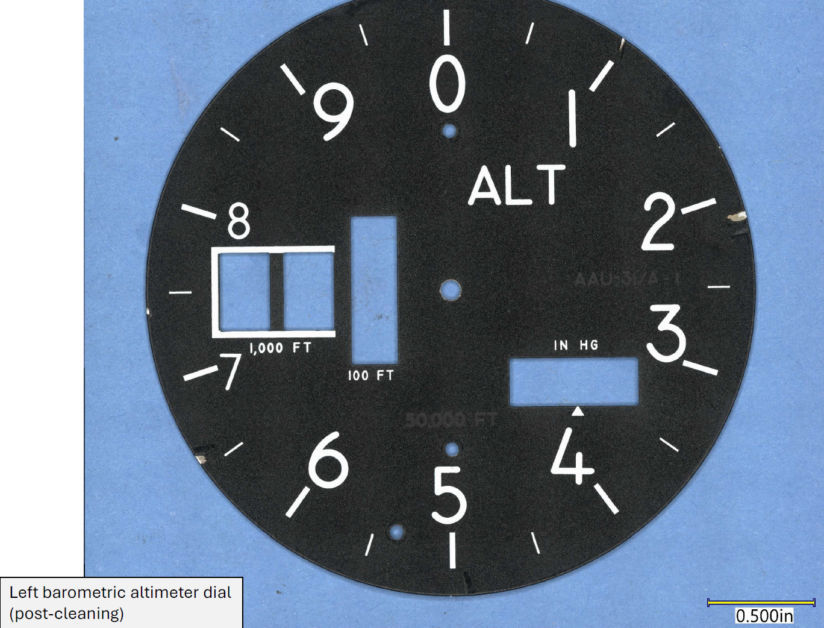
Among the numerous contributing factors cited by the U.S. National Transportation Safety Board (NTSB) in the fatal Jan. 29, 2025, midair collision between a PSA Airlines Bombardier CRJ700 and a U.S. Army Sikorsky UH-60 Black Hawk was the helicopter’s faulty barometric altimeter.
The NTSB said in its final report on the accident, which killed all 67 passengers and crew in both aircraft, that the barometric altimeter indicated the helicopter was 200 feet above ground level — the approved height for that portion of its route, which crossed the CRJ’s approach path to Ronald Reagan Washington National Airport (DCA). The NTSB found that, in reality, the helicopter was nearly 100 feet higher.
A barometric altimeter is a type of aneroid barometer, an instrument that measures atmospheric pressure. An aneroid barometer uses an aneroid cell, a small, flexible, partially evacuated container. It expands as air pressure falls and contracts when pressure rises. These movements are enhanced and converted to a readable display.
Atmospheric pressure is the result of the weight of the air above the altimeter and its effects on air density. As you ascend, there is less air above you, the air density decreases, and the pressure goes down, very rapidly at low levels and more slowly at higher levels. The average relationship between height and pressure has been calculated for what is called the standard atmosphere. Utilizing this relationship, Paul Kollsman in1928 invented the barometric altimeter, basically a barometer that reads in height rather than in some unit of pressure. A barometric altimeter uses a stack of aneroid capsules or wafers connected to a display.
So, a barometric altimeter converts the measured pressure to an elevation. However, many other factors can influence this relationship. With atmospheric pressure changing rapidly close to the ground, anything that can affect the pressure/height relationship can produce significant height errors. To allow for the elevation of the land and various weather systems, the actual pressure (or station pressure) is converted to a sea level pressure by following the standard atmosphere pressure increase with decreases in elevation. Standard sea-level pressure is 29.92 inHg or 1013.25 hPa. This converted pressure is then used as the altimeter setting, which the pilot sets in a small window on the altimeter, known as the Kollsman Window, while on the ground.
When testing three other Black Hawks, the NTSB noted that the barometric pressure altimeter errors were within acceptable standards, no more than 29 to 45 feet off, while the helicopter was on the ground with the engine off. However, once the rotor blades began turning, the altitude error grew to between 80 and100 feet too low. It is believed that the downwash from the helicopter blades significantly increased the air pressure at the static pressure vents, which are part of the pitot-static system, thus producing the erroneous reading.
By design, these vents are located at the rear of the cabin to minimize downwash effects. However, the external fuel tanks on the Black Hawk, which disrupt the airflow around the fuselage and create a high drag configuration, exasperate this problem. Older UH-60L model Black Hawks such as the accident helicopter use 1970s-era analogue sensors. Newer helicopters use advanced computer technology to compensate for these types of errors. These problems were known by the Army but never mentioned in pilot manuals.
The NTSB cited as one of the probable causes of the accident “the Army’s failure to ensure pilots were aware of the effects of error tolerances on barometric altimeters in their helicopters, which resulted in the crew flying above the maximum published helicopter route altitude.”
Radio altimeters function somewhat differently. A radio altimeter sends out electromagnetic waves that are reflected back from the surface to a receiver. The time needed for this process can be converted into a distance.
At low levels, radio altimeters are preferred over barometric altimeters because they are more accurate. For example, the accident helicopter also had a radio altimeter that was reading correctly at 278 feet. However, there is no indication that the pilots referenced this instrument.
Among the safety recommendations included in the accident report was a call for the Army to “Incorporate information within the appropriate operator’s manual for all applicable aircraft on the potential total error allowed by design that could occur in flight on an otherwise airworthy barometric altimeter, including the increased position error associated with the external stores support system configuration.”
Image: NTSB
Edward Brotak, Ph.D., retired in 2007 after 25 years as a professor and program director in the Department of Atmospheric Sciences at the University of North Carolina, Asheville.