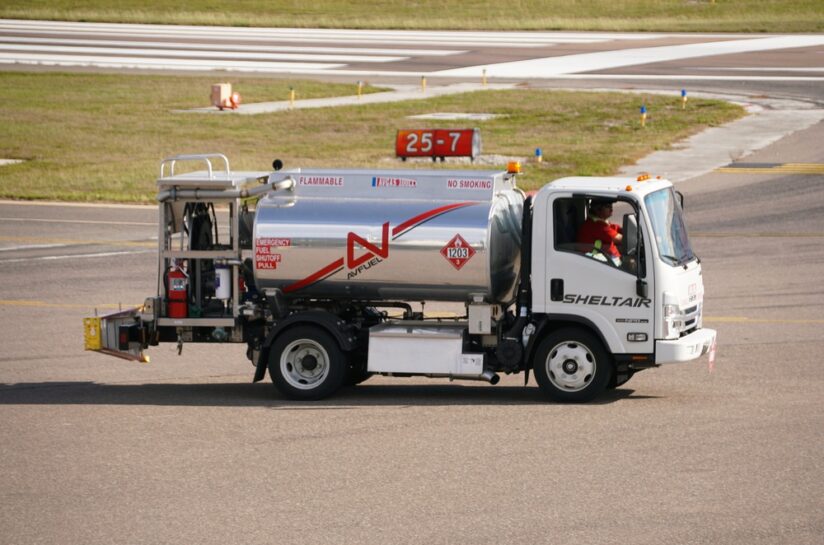
The U.S. Federal Aviation Administration (FAA) plans to equip 1,900 of its vehicles, located at 264 airports nationwide, with transponders that will help air traffic controllers track them on airport runways and taxiways.
The FAA said in a May 13 statement that the transponders would be installed in vehicles operating at the 44 airports that use airport surface detection equipment, model X (ASDE-X) to track aircraft and vehicles on the ground and at 220 airports equipped with a similar system known as ADS-B airport surface surveillance capability (ASSC). The installations will cost $16.5 million, the FAA said.
At the same time, the agency noted that airports can use federal grants to finance the installation of transponders on their vehicles and suggested that airport officials could encourage airlines and other operators of vehicles on airport surfaces to do the same. More than 50 airports have expressed interest in installing the transponders, the FAA said.
“Vehicle movement area transmitters (VMATs) help prevent dangerous runway incidents, and by accelerating the deployment of this technology, we’re closing critical visibility gaps on our nation’s runways and taxiways,” FAA Administrator Bryan Bedford said.
The FAA said the project had been in the planning stages for several months and stepped up its efforts after the March 22 accident at LaGuardia Airport in New York in which an Air Canada Mitsubishi Heavy Industries RJ Aviation CL-600 struck an aircraft rescue and firefighting truck, which lacked a transponder, soon after landing. The accident killed both pilots.
High Cabin Air Temperatures Seen as Potential Risk
Occasional extremes in temperature in airplane cabins may expose passengers and flight attendants to environmental stressors that may result in health and safety risks, according to a study by the U.S. National Academies of Sciences, Engineering, and Medicine.
The study, released June 3, included recommendations to the U.S. Federal Aviation Administration (FAA) that called for establishing a better program for monitoring, recording, and evaluating cabin temperature and humidity, encouraging airlines to incorporate the evaluation of temperatures into topics covered by airline safety management systems, and improving the use of health and safety data to help identify potential thermal hazards.
Flight attendant input should be incorporated into real-time operational decisions in situations involving unsafe cabin temperatures, according to a report on the study, which added that, when possible, flight attendants should have more flexibility in uniform options.
“The enclosed environment of an airplane cabin can expose passengers and flight attendants to a range of environmental stressors,” the report said. “Among these, temperature — along with humidity — has received increasing attention due to reports of excessively hot or cold cabin conditions, both during ground operations and in flight.”
The report added that extended exposure to heat or cold in the cabin “may contribute to a range of physiological, cognitive and behavioral effects” and interfere with flight attendants’ safety-critical duties.
The document noted that regulations do not exist that define temperature requirements during normal operations and said that, because passengers and flight attendants have limited ability to alter the cabin environment, “understanding and managing temperature-related risks is essential for maintaining safe air travel.”
Anticipating ADS-B
Nearly half of U.S. airline executives surveyed say their organization has equipped at least some of its aircraft with automatic dependent surveillance–broadcast (ADS-B) In, according to a survey released by avionics manufacturer and pilot training provider Acron Aviation.
Results of the survey of 100 executives, conducted in April and released in early June, show that slightly more than half said their airline has not yet acted, although about 40 percent said ADS-B technology was being evaluated in preparation for future investment. In addition, 86 percent said their airline could be ready to comply with a potential mandate for installation within three years.
Legislation pending in the U.S. Congress would make more aircraft subject to requirements that they be equipped with ADS-B.
Every survey respondent said he or she was familiar with ADS-B In, but 51 percent said their knowledge was “general or superficial” — a characterization that Acron said showed that, despite general familiarity with the concept, “the depth of engagement with the technology is still limited. … Only half the story has been heard, and decisions are being made without complete knowledge of the value the technology can deliver.”
ADS-B is satellite-based technology that determines an aircraft’s position and transmits that information and related data to other users, primarily other pilots and air traffic control. ADS-B In provides traffic and weather information to pilots of aircraft with appropriate ADS-B equipment; ADS-B Out broadcasts an aircraft’s GPS location, airspeed and other information. Aircraft operating in most controlled U.S. airspace are already required to have ADS-B Out.
Image: Khairil Azhar Junos/Shutterstock.com